

English as a whole is an extremely tough subject to get a H1 in. However, paper 1 is significantly easier than paper 2 (in my opinion!), yet people overlook it. Making paper 1 your top-scoring paper is crucial, and that starts with acing the QA.

For most of you, the comprehension will be the first question you do in the entire Leaving Cert. You want to start strong.
In this article, I will give you tips on how I aced the QA (comprehension). I will break down the question, share my strategy for effectively answering any QA, and also share my study notes that helped me get a H1.
The different types
There are many types of genres for QAs. Choosing the one that fits your strengths is the first step.
Different QAs are based on different types of languages. The key to acing this question is to first identify what language is being examined, because your answer must reflect this.
The main types of languages are:
- Language of Narration
- Language of Persuasion
- Language of Information
- Language of Argument
- Language of Aesthetics
In your preparation for the exam, it will be key to identify which language is your strength.
For me I personally loved the Language of Persuasion and Aesthetics, as there were always enough points I could write about.
Each language has some most common points you can talk about. For example, in the Language of Aesthetics, you will almost always be able to talk about the use of language devices like similes, metaphors, etc.
For a more detailed breakdown of this, I would recommend checking out this article. It breaks down the different languages in English.
Breakdown of QAs
Almost all QAs have the same composition. There are 3 parts to the question, and they tend to be as follows:
(i): The find and collect question:
Mostly, you are asked to find 3 things from the text and comment on them. This question is very simple if done correctly.
The key to scoring marks in this part is to effectively quote from the text, and most importantly, choose 3 (or however many they ask for) unique points.
How long should the answer be?
I would aim for roughly 3/4th of a page or about 200ish words.
The structure:
- A small intro (just a sentence or two is fine)
- 3 developed paragraphs – one for each of the unique points
- A small conclusion (again, just a sentence or two)

(ii): The ‘personal opinion’ question:
This question requires you to personally engage with the ‘concept’ of the text and give your opinions on it.
Remember, the driving force of paper 1 is that the examiner wants to hear YOUR voice. So this question is key. Just be honest and be you!
Tip: I would recommend quoting at least once or twice from this text, too. It’s always a good idea to tie in your answer with the text.
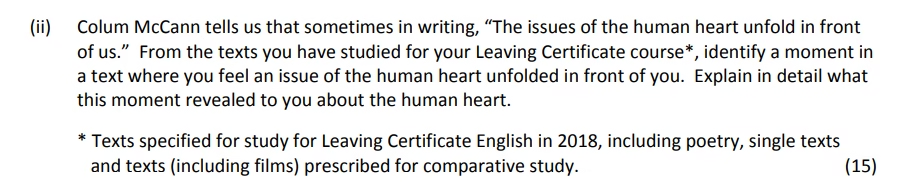
Variation (Type 2): One variation to this question that has been introduced is that you are required to answer the question by referring to a text you have studied in Paper 2.
I would again aim for about 3/4th of a page, or 200ish words for this part.
Type 1:

Type 2:
(iii): The language question:
In this question, you are asked to analyse the writer’s language style. This part is worth the most marks of Question A.
I find that the best way to answer this question is to discuss each technique the writer uses in a separate paragraph.
For example, if you are dealing with the language of persuasion, some of the key language devices you should look out for are:
- Rhetorical questions (examiner loves seeing these!)
- Personal anecdotes
- Similes
- Metaphors
- Hyperboles etc.

I would aim for about 1.5 pages or roughly 400ish words for this question. For the above question, the structure of the answer would be an intro, 4 well-developed paragraphs, and a conclusion.
H1 notes on QAs
As I said, QA is the first question you answer. You want to get off to a good start. But the problem is that it’s very difficult to understand what exactly a H1 answer looks like.
To help with that, I have made comprehensive notes on QAs outlining how I answered them.
The notes include H1 quality answers to the Question for the following years:
- 2021 (text 1 and text 3)
- 2016 (text 2)
- 2023 (text 3)
I break down the answers and explain exactly why they deserve a H1. This will hopefully show you what a H1 answer looks like.
And, if you’re still not convinced, you can download the first few pages of the notes first!
Conclusion
Hopefully, this article has shown you that QA is not that scary. It genuinely is a very doable question. But it’s crucial not to get complacent.
Remember, scoring high marks in this question is very possible, but so is doing terribly!
With a bit of practice, you can definitely make this one of your strong suits. Hopefully, you found this article useful.
If you’d like, you can check out our other articles on the LC too:
- How to get a H1 in English?
- How to get 625 points in the Leaving Certificate?
- How to get a H1 in every subject?
All the best!
Post Disclaimer
The information contained in this post is for general information purposes only. The information is provided by How to get a H1 in QA of English Paper 1 and while we endeavour to keep the information up to date and correct, we make no representations or warranties of any kind, express or implied, about the completeness, accuracy, reliability, suitability or availability with respect to the website or the information, products, services, or related graphics contained on the post for any purpose.