

Emily Dickinson is one of the Leaving Cert 2027 prescribed poets. She is extremely popular with examiners for her cryptic style, but that also makes her tricky to study. However, scoring top marks is easier than it seems.
In this article, I will share tips and tricks on how I studied Emily Dickinson, and provide you with H1 quality Emily Dickinson study notes as well!

Why should you study Emily Dickinson?
Emily Dickinson’s poetry frequently appears on the Leaving Cert, but many students struggle because they don’t fully understand her work.
Years she appeared on the exam:
Dickinson has appeared in the following years:
- 2024 (my year!)
- 2022
- 2020
- 2016
- 2014
- 2011 etc.
As you can see, there’s a slight pattern: she often appears every two years.
She isn’t prescribed for 2026, but gaps like 2011–2014 show that her appearing in 2027 is still very possible
While these patterns aren’t a guarantee, they clearly indicate that Dickinson is worth studying.
What do examiners look for when examining Emily Dickinson?
The key to Emily Dickinson’s poetry is her cryptic and erratic style of writing. Examiners love asking questions about this unique style.
Most poetry questions about Dickinson tend to be the same. The examiner wants to see, firstly, that you understand her poetry and can engage with the deeper meanings, and secondly, that you can recognise her unique style of writing.
LC 2024:
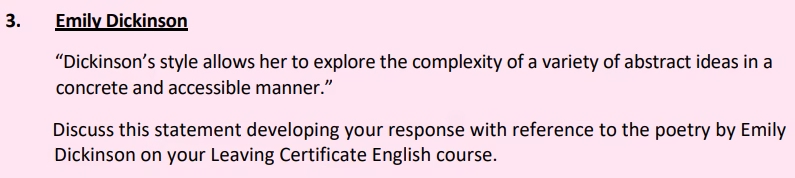
LC 2022:

LC 2020:
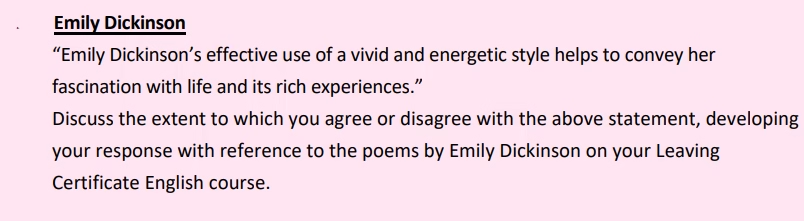
Driving force of all the above: Do you understand her style, and can you personally engage with it?
Why is it easier to score high marks on her questions?
Every time I answered a question on Emily Dickinson, I always scored a H1 (including the actual Leaving Cert). And I can’t say the same about other poets!
Dickinson’s poetry is highly implicit, which means that there is no single correct interpretation.
This is perfect for the Leaving Cert, as examiners reward unique perspectives and personal engagement. And that’s where the H1 lies.
Study notes on Emily Dickinson
To help you with all the above, I have compiled all my study notes on Dickinson.
These notes include:
1). Personal responses (analysis) to the following poems:
- “Hope” is the thing with feathers
- I felt a Funeral, in my Brain
- There’s a certain Slant of light
- I Heard a fly buzz – when I died
- A Bird came down the Walk
- After great pain, a formal feeling comes
2). H1 answers to the following questions:
- LC 2024 (96% – official result corrected by SEC)
- LC 2022 (96% – corrected by my teacher)
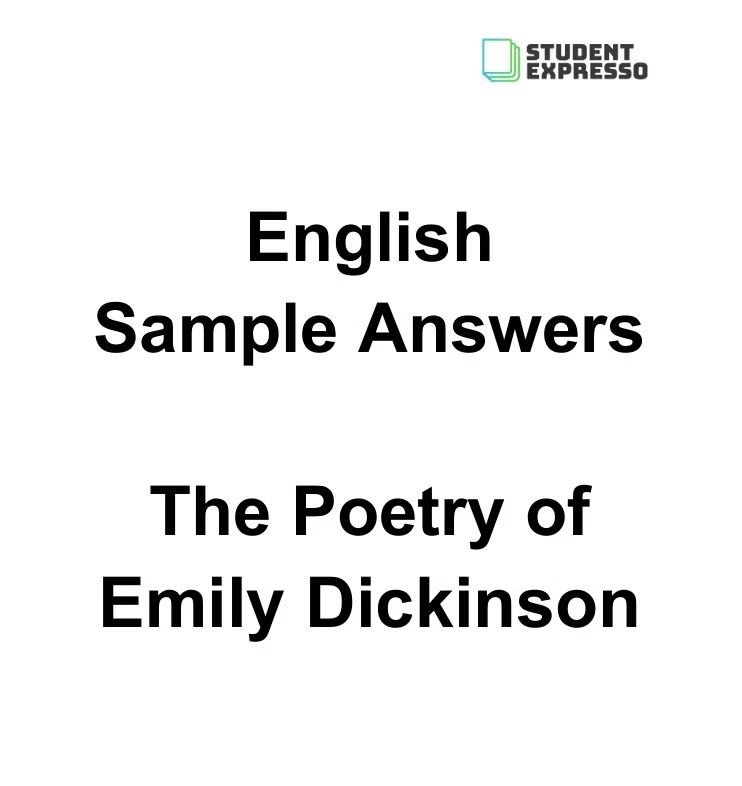
These notes are fully free right now (I promise, no catch!). Reason being, I have other notes too (Notes on the poetry of W.B. Yeats and notes on studying Question A in Paper 1), so I want to give you a feel for what they are.
If you find the notes on Dickinson useful, consider checking out the other 2 notes. It will massively help the website, and hopefully, will help you too!
How to effectively study her work?
1). Understand who Emily Dickinson was:
This includes reading about her upbringing, the influence of religion in her work, struggles with mental health, etc.
2). Write a personal response to each poem you’re studying:
A personal response is an analysis of the poem. This should highlight key moments of the poem, poetic devices used, and how they made you feel.
This makes answering questions significantly easier.
3). Practise a couple of past paper questions on Dickinson:
This is the only way to get better at poetry questions: practise.
Quick analysis of her style
To give you a feel for what level of detail the notes contain, here’s a quick analysis of Dickinson’s style. All my answers on Dickinson incorporate these elements, and much more!
Irregular punctuation:
Dickinson uses punctuation to convey her emotions. Her punctuation seems very random. For example, she uses excessive dashes.
Interesting points from ‘Hope is the thing with feathers’
- She uses no commas
- Only dashes (but few of them too)
- Only a single full stop at the end
In your analysis of this poem, you should point that out. Perhaps, she used little punctuation to emphasise the theme of the poem, and to have a seamless flow.
Random Capitalisation:
Dickinson is known for randomly capitalising some words. At times, there’s an obvious purpose, but mostly, it’s up to your own interpretation.

She capitalises the word ‘Gale’ here. Perhaps that’s to lay a strong emphasis on tough times that all of us endure, and to make it a thought-provoking experience for the readers.
Made-up words:
Dickinson regularly takes creative liberties with language, often inventing words to express ideas with greater precision and intensity.
An example of this appears in “A Bird, came down the Walk”, where she uses the self-created word “plashless” to convey a meaning no conventional word could fully capture.

Finally,
Hopefully, this article has shown you that Emily Dickinson genuinely is a brilliant poet to score high marks on.
I’d definitely recommend giving it your best to study Dickinson – it was worth it for me anyway!
For further help in your preparation, do consider checking out the notes above, and for general tips for English in the Leaving Cert, you can read these articles:
- How to get a H1 in English?
- How to get 625 points in the Leaving Certificate?
- How to get a H1 in every subject?
Post Disclaimer
The information contained in this post is for general information purposes only. The information is provided by How to study Emily Dickinson for the Leaving Certificate? and while we endeavour to keep the information up to date and correct, we make no representations or warranties of any kind, express or implied, about the completeness, accuracy, reliability, suitability or availability with respect to the website or the information, products, services, or related graphics contained on the post for any purpose.