

Poetry is a key component of English Paper 2, yet it’s very difficult to score high marks in these questions. Studying for poetry isn’t easy either, because it’s tough to know what’s required to achieve a H1.
In this article, I will break down the poetry question and share tips and tricks on how you can ace any of these questions, regardless of which poet you choose to do.
Disclaimer: I’m not claiming that if you follow everything in this article, you will ace the mocks. This is a comprehensive overview of some of the things I did. This worked for me. Feel free to take whatever inspiration you’d like. Happy reading!

Structure of poetry answers
Regardless of which poet you choose to answer, the structure stays the same.
All my poetry answers followed this structure:
- An introduction: State your thesis + the poems you include in the answer.
- 6 well-developed paragraphs: Each paragraph dedicated to a poem.
- A conclusion: how you answered the question + some praise for the poet (optional).
I would personally recommend using 5/6 poems for whatever poet you choose. The reason for this is that you want to have 6 well-developed paragraphs.
If one of the poems is really long and there’s a lot to talk about, then you can do 5 poems too.
More on well-developed paragraphs:
Each poem you analyse deserves at least one paragraph. In this paragraph, you need to explain how this poem answers the question asked.
VERY IMPORTANT: Do not just explain the poem. Explaining each stanza won’t get you marks. The key is to identify key parts of the poem and demonstrate how they highlight the question being asked.
Study notes to help you get started
I know studying poetry is difficult. My biggest struggle was I couldn’t understand what actually deserved a H1.
To help you study poetry, I have compiled my study notes on two poets. These notes contain a comprehensive way to study the poets. The notes contain literally everything I know about the two poets, respectively!
The first notes on Dickinson are completely free for a while – no catch, I promise. This is just so you can get a feel for whether the type of notes I make is useful or not.
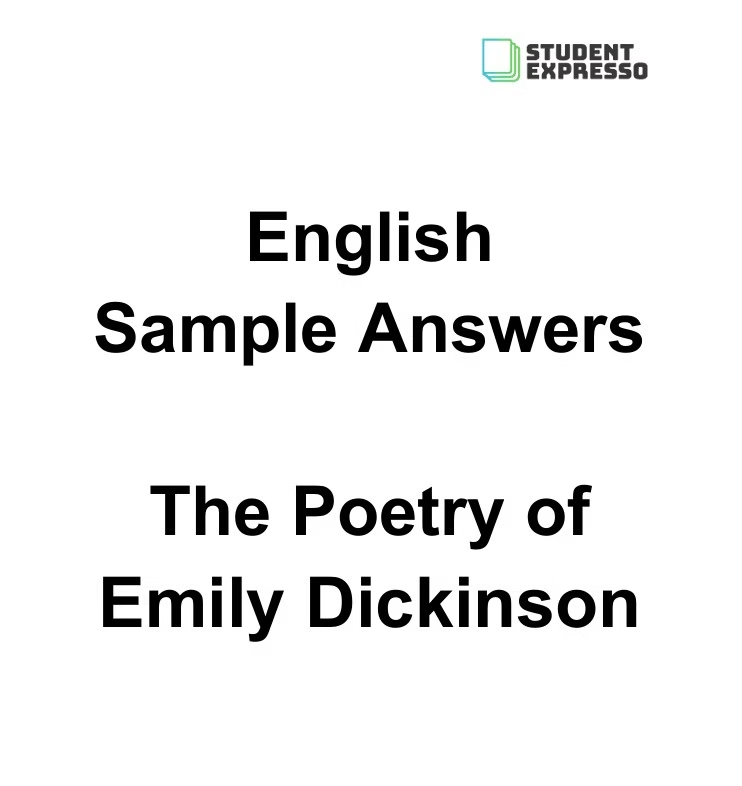
1) Personal responses (analysis) to the following poems:
- “Hope” is the thing with feathers
- I felt a Funeral, in my Brain
- There’s a certain Slant of light
- I heard a Fly buzz – when I died
- A Bird came down the Walk
- After great pain, a formal feeling comes
2) H1 answers to the following questions:
- LC 2024 (96% – official result corrected by SEC)
- LC 2022 (96% – corrected by my teacher)
W.B. Yeats:
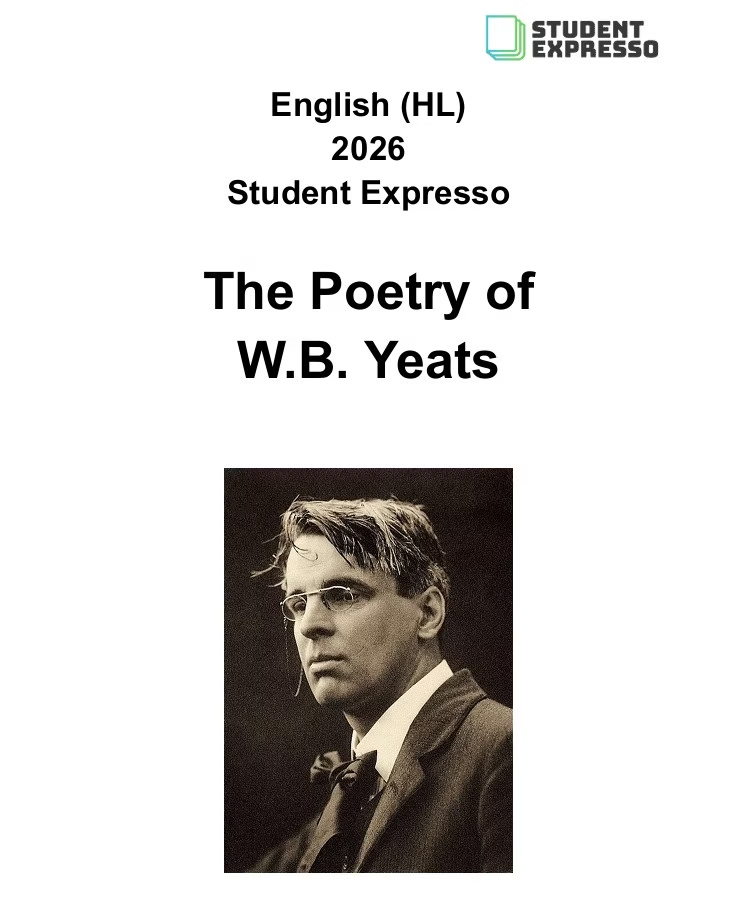
1) Personal responses (analysis) to the following poems:
- The Lake Isle of Innisfree
- September 1913
- Easter 1916
- An Irish Airman Foresees His Death
- Sailing to Byzantium
2) H1 answers to the following questions:
- LC 2022 (H1)
- Mock Question 1 (H1)
- Mock Question 2 (H1)
3) Bonus: Introduction to studying W.B. Yeats – his background, motivations, and influences for his poetry.
In total, that’s 31 pages content!
I’m obviously biased, but I feel these notes are worth it. Also, if you buy the notes and feel unsatisfied, you can return them within 7 days too!
Ok, now onto breaking down poetry questions, and my approach to them.
Breaking down the question
As I said, all questions are essentially the same. It’s important to understand the driving force of the question.
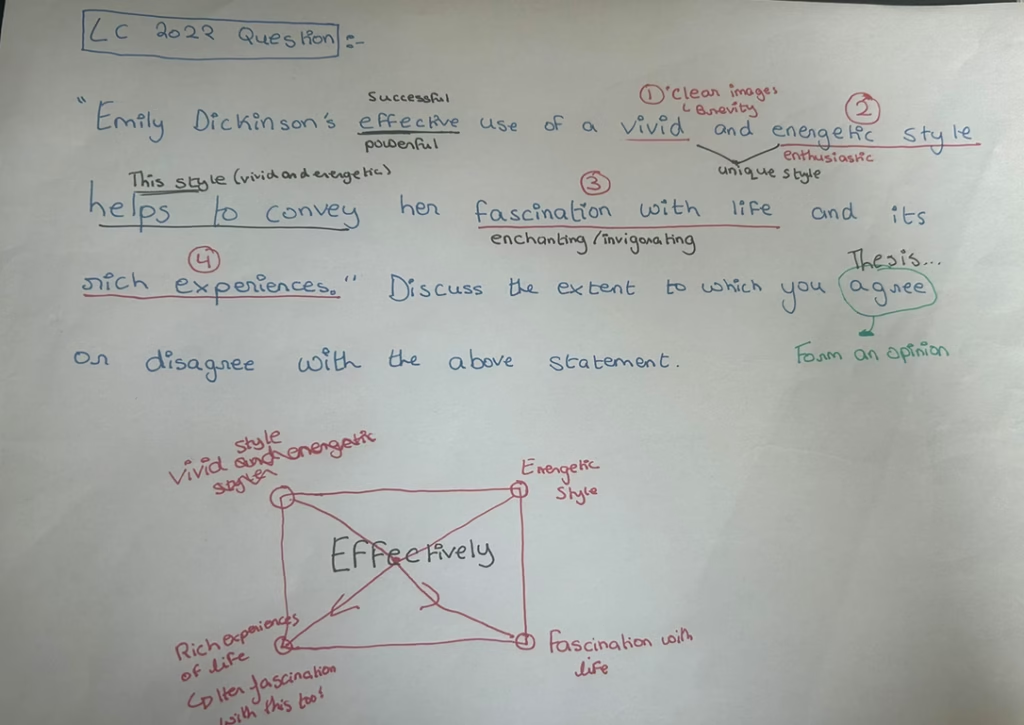
Most questions will have 3 or 4 points that the examiner wants you to address. These will make up your thesis.
Before I would answer any poetry question, I would always take a couple of minutes to break down the question.


Frequently Asked Questions (FAQs)
What is a thesis?
I have mentioned the word thesis a lot of times now. But what is a thesis?
This is perhaps the most important part of doing well in the poetry questions. The thesis is basically just you restating the question’s most important parts.
For example, in the picture I showed above, your thesis would be made up of all the points in red.
Every paragraph must come back to the thesis. When you talk about specific quotes or poems, you should explain why this ties into your thesis.
My thesis on the above question:
To show you what a thesis looks like, here’s my thesis for the 2022 Emily Dickinson question:
Emily Dickinson conspicuously exhibits her profound fascination with life and its rich experiences through her effective use of a vivid and energetic
style, beautifully complimented by the unique and thought-provoking
images incorporated throughout her poetry
How to prepare for the poetry question?
The way I studied each poet was by writing personal responses to each of the poems I am studying.
What’s a personal response?
A personal response is your own analysis of a poem, which includes
looking at the language, poetic techniques, and emotions, while also engaging
with it in a meaningful way.
Why bother?
Poetry questions for each poet tend to be similar year after year. Examiners want to see if you understand the poet. By having an in-depth analysis of each poet in your bag, you will be confident when writing answers.
You will know exactly which quotes to include in your answer. And best of all, you’ll know how to word it as well – since you would’ve done so in your personal response.
Note: To further see what a personal response looks like, have a look at the personal responses I have included in my notes above.
How long to spend?
This is up to personal preference and depends on how long you choose to spend on other questions.
I would spend about 1 hour answering the poetry question. The reason for this is that I knew poetry was my strong suit, so I had to make sure I scored really well in it.
Note: Make sure to plan wisely – you don’t want to run of time for other parts!
How much to write?
My teacher recommended writing about 800 – 1200 words. This is very doable in the time given as well.
How many poets to study?
This does depend on your year. I would always recommend studying enough poets so you have a choice.
Why? In my year (2024), Sylvia Plath was widely predicted. And in the end, she was in the paper too. But the question on her was quite strangely worded and something that most would not have been prepared for.
Having a backup plan is always recommended!
Conclusion
Hopefully, this article has shown you that doing well in poetry is very doable.
The trick is to have thorough preparation.
For further help in your preparation, do consider checking out the notes above, and for general tips for English in the Leaving Cert, you can read these articles:
- How to get a H1 in English?
- How to get 625 points in the Leaving Certificate?
- How to get a H1 in every subject?
Post Disclaimer
The information contained in this post is for general information purposes only. The information is provided by How to get a H1 in Poetry in English in the Leaving Cert? and while we endeavour to keep the information up to date and correct, we make no representations or warranties of any kind, express or implied, about the completeness, accuracy, reliability, suitability or availability with respect to the website or the information, products, services, or related graphics contained on the post for any purpose.